Breed Character and General Appearance
The Corriedale should at once give the impression of being a stylish sheep that is well balanced, heavy shearing, growthy and hardy. It is a dual purpose sheep; therefore, consideration should be given to both carcass and wool.
HEAD
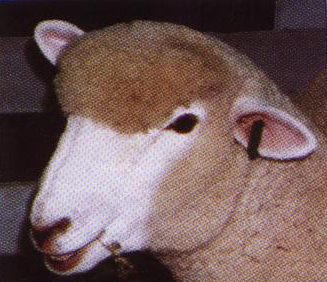
Breed character represents the combination of characteristics that distinguish Corriedales from other breeds. More than any other feature the head gives the breed its character and individuality. The head of the ram should be bold and strong. It should be in proportion with the rest of his body and should display marked masculinity. The ewe’s head should indicate her femininity, but in no case should it be over refined. The nostrils should be wide and open with a black nose preferred. A solid pink or white nose should be discouraged.
The ears should be of medium size, preferable white, thin, and soft. Black or blue spots on ears are not defects, but black or brown spots on head hair or wool are defects.
The Corriedale should have a bright, alert eye. Over-large tear ducts and excessive redness around the eyes are objectionable. The area immediately surrounding the eye and a channel from the eye forward should be completely free of wool. The wool should not grow on the bridge of the nose, below the level of a line drawn from the base of the ear through the eye and continued at the level forward to the nose.
A good covering of wool over the poll is desirable in both sexes. The sheep must be hornless and should have a well defined pit. Slight rudimentary horn growth (scurs) found attached to the skin on the ram’s head should be considered a minor defect; however, horn growth attached to the bone is unacceptable.
The mouth should display correct bite, neither over-shot nor under-shot , with the front teeth centered on the upper pad.

II. Conformation
A. Body Conformation and Muscling
Front Quarter
Neck: The neck should be broad and strong and should fit smoothly into the shoulder with no drop in front of or behind the shoulders. The underside of the neck should be free from folds or wrinkles, although this defect may be forgiven if not present to a major degree. The neck should be long enough to contribute to an overall balanced appearance.
Shoulder: The importance of a reasonably wide and level shoulder cannot be stated too emphatically. Badly set, prominent shoulder blades, causing a depression behind the should, are a major fault and must be condemned. Corriedales should be smooth shouldered. Coarse shoulders and / or open shoulders should be considered a fault.
Chest: The chest should be wide and deep. These points are necessary both for the production of meat and for the constitutional vigor of the animal. It is in a the depth and width of the chest, and particularly in the depth, the that the vital organs of heart and lungs are housed. A shallow, narrow chest indicates small lung capacity, cramped heart room, and in general a weak, delicate constitution.
Underline: The should be level and as parallel to the back or top line of the body as possible. The tendency to slope upwards from the stomach to the chin of the sheep is a bad carcass and constitutional fault. The flank should be deep and full.
Middle
Ribs: Deep and well-sprung ribs should arch out and slights upwards from the spine and carry deeply down to the low brisket. The spring or arch of the ribs is essential for constitutional vigor and fattening qualities, and is also necessary to insure the maximum meat in the chop. The greater the arch to the spring of ribs, the more meat there will be in the important portion of the lamb. Back: The back should be level and straight and reasonably long. Any tendency to a short dumpy back between should and hip, or between hip and tail head, is a serious conformation fault. A slight gradual lowering of the back line in the center of the back is not important.
Loin: The loin should be as long, wide and deep as possible. Muscling in this region is very important since this is the highest priced area of a lamb carcass. Loin eye area is an important criteria in carcass evaluation.
Hindquarters
Thighs: The leg of lamb or mutton should be wide and full as viewed from the rear. Length of rump is also an important aspect of total thigh evaluation. Width behind denotes a wide pelvis aperture and ease of lambing.
Rump: The top line should continue out level and straight to above the dock. Tendency to slope from the hip bones backwards and downward should be avoided.
B. FEET AND LEGS/STRUCTURAL CORRECTNESS
Feet: The feet should be hard, oval in shape and neither completely round nor long and narrow. The should be large enough to bear the animal’s weight in soft ground, and yet not so large that they tend to splay open in walking. The feet should be black in color, though streaky feet or lighter colored feet are permissible, if they are not totally white.
Pasterns: The pasterns supply the spring and cushion of an animal’s walk. A tendency toward too straight a pastern means a jarring, stilted walk. On the other hand, too long and sloping a pastern places too great a strain on the tendons and joints and is a weakness.
Legs: The legs should be of moderate length, well apart and should set straight and be accompanied by strong bone. The bone of the legs should be heavy, and flat or oval in shape. This, light, round bone is a major fault. The legs should be set perpendicularly under the sheep, the front legs directly under the shoulder blades and of similar width to the shoulders. The should stand square in front and behind, and squarely on its feet. The hind legs should carry the hocks in line with the pin bones.
Testicle Size and Soundness: Testicles should be uniform in size, adequate in size for age, well descended from the body, and have no abnormalities. The scrotal circumference on rams 18 months of age or older should be a minimum of 35 centimeters, and 30 centimeters for a 6-month-old ram lamb.
C. BALANCE AND SIZE
Balance refers to the blending together of body parts. The parts of the sheep should be in proportion and any tendency toward extremes should be avoided. Corriedales are a dual purpose breed with growthiness being very important. Animals should be longer than they are tall, and adequate muscling and body capacity should be given strong consideration. Mature rams should weigh two hundred and seventy-five pounds (275 lbs) and up and mature ewes one hundred and seventy-five pounds (175 lbs.) And up.
An updated summary of weights and measurements of animals in recent National Sales can be found as an insert in the publication.
III. Wool
A. Quality, Character, and Uniformity
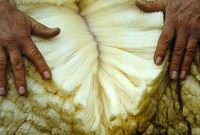
The Corriedale should carry a heavy, even fleece of bright, lustrous wool, showing good staple length and density, with a well-defined lock, an even tip, a uniform grade (spinning count) throughout and a uniform crimp that corresponds with breed standards. The fleece should be free from hair, kemp, and black or brown fibers. The desired quality is a long staple, bulky 50-58 spinning count (of medium grade, approximately 25 to 31 microns) of even density. A somewhat lower spinning count, especially in a ram, should not be discriminated against provided that it is free from any harshness. In rams, the scrotum should be reasonably covered with wool that is not too course in texture.
Uniformity of Grade: The breeder should strive for the greatest uniformity of fleece possible. The wool known as “belly wool” should not extend above an imaginary line running from the fore flank to rear flank. This may be a moderate to severe fault depending on how high belly wool comes up on the side. Variation in grade from side to britch should be minimal.
Tip: An even tip is desirable. The long pointed tip, except in lambs, is to be avoided.
Crimp: The crimp should be clearly defined and even in character throughout the length of the fiber. It should be of a type and standard in keeping with breed spinning quality. It should be noted, however, that this quality is highly affected by environmental conditions.
Staple: Length of staple of a fleece is the major point in attaining maximum weight of wool. Breeders should strive for the maximum length possible in relation to count, without impairing the density of the fleece, or the meat and milk producing qualities of the sheep.
B. Density
Corriedale fleeces should show a great deal of density without feeling harsh to the touch. A soft fleece is very desirable. Very open fleeces often contain more vegetable matter and shed less water than dense fleeces. Placing too much emphasis on the density can result in reduced staple length and fleeces that are harsh to the touch, however.
C. Covering
Head Covering: The head should have a good covering of wool of similar type to the general fleece. A tendency for the head wool to vary slightly in count is not of great importance: however, weak and wasty wool around the ears or between the ears is a fault. The wool covering the poll and front portion of the head should not contain an excess of nonwool fibers, preferably none at all. This is one of the first places in the fleece where such faults may occur and indicates at least a possibility of similar faults in the main fleece in later generations. The horn depressions should not show an excess of course hair, or show dark or brown coloring. The excessively bare head leads to an eventual loss of wool weight and to weaknesses in the fleece of the breed, if not in the individual, and to the development of a plain, unattractive type of sheep. The other extreme is the wool blind animal. The Corriedale head covering should be somewhere within these broad limits.
Leg Covering: The legs should be free from black or brown coloring in the wool or hair, and as free as possible from kemp. A leg that is well wooled down to the fetlock is preferred.
The qualities of brightness and luster play an important part in the fleece evaluation and in the value of a fleece. Fleeces should be white or creamy white in color. Environmental conditions can temporarily affect fleece color. However, a canary yellow color exists in some Corriedales that has a genetic link and this should be discriminated against.